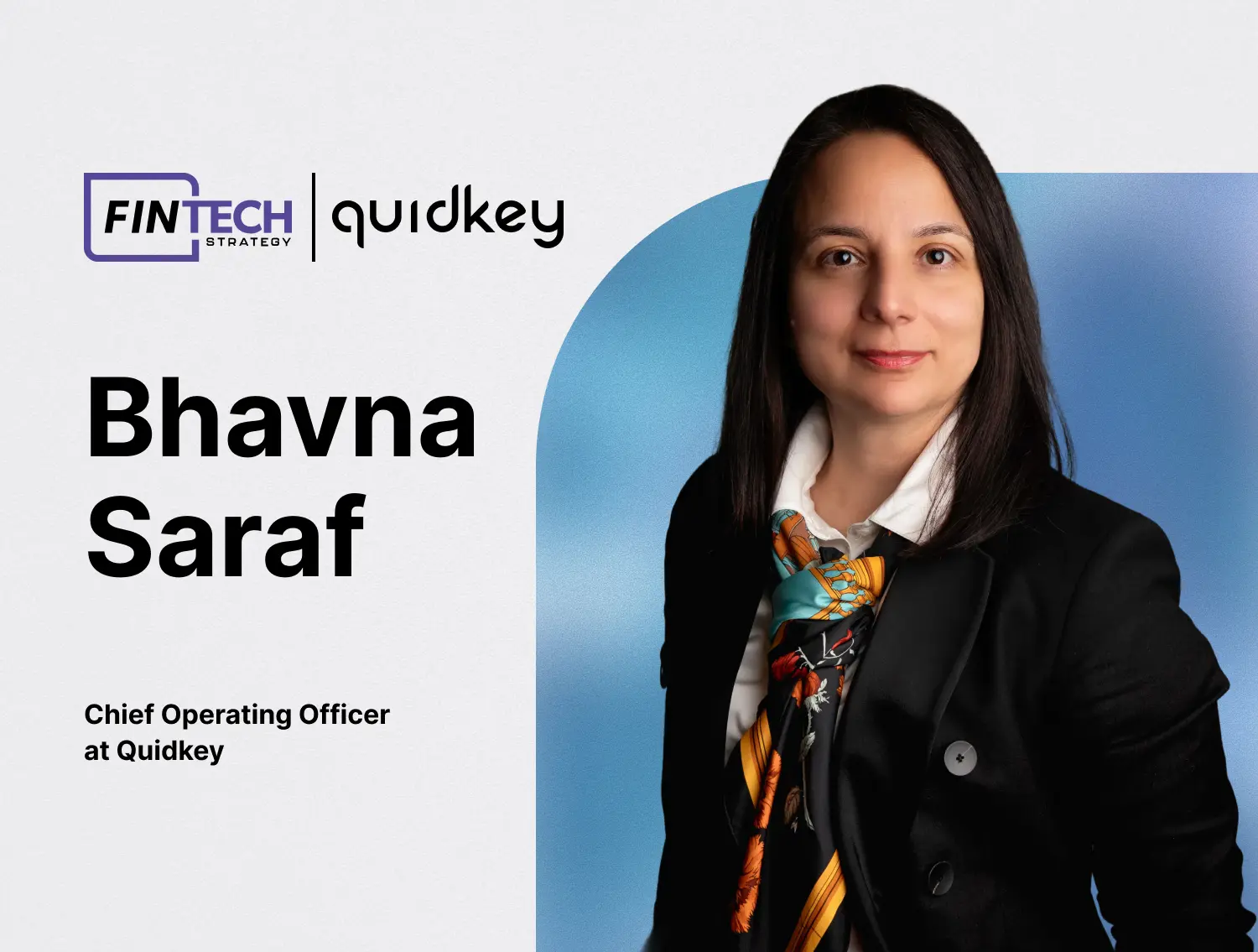
Chief Operating Officer Bhavna Saraf gives us the lowdown on the genesis of Quidkey and how it is leveraging APIs & AI to transform open banking networks into merchant-ready solutions driving higher conversion and borderless coverage with no-cost simple integration
Founded in early 2023, Quidkey has quickly established itself as a trusted provider of next-generation Account-to-account (A2A) payments. Also known as ‘Pay by bank’. Leveraging AI-powered bank prediction, instant settlement, and a streamlined user experience, Quidkey has created a bank-branded checkout system powered by Open Banking. It combines refunds, rewards, and real-time settlement bringing together cash flow, trust, and convenience for merchants. Its growth in the UK and EU is now being expanded to service Australia and the US corridors.
Chief Operating Officer Bhavna Saraf met CEO Rob Zeko and CTO Rabea Bader, Quidkey’s co-founders, at the end of her time with Santander. They were pitching Quidkey’s offering to top bank executives. Their vision was ambitious:
- Democratising access to bank products amongst its customers through a single channel
- Leveraging and monetising its API stack for payments
- Providing value add services making open banking usable for businesses
“I remember thinking it wasn’t a standard FinTech pitch,” recalls Bhavna. “It was a real infrastructure story that was additive and complimentary to all ecommerce ecosystem players, merchants, banks, PSPs and consumers. When I began figuring the next steps in my career, Rob reached out. The discussion evolved into a collaboration – the timing was serendipitous.
Rob believes A2A payments are the future of commerce, and merchants deserve simpler, faster and fairer ways to get paid. “We’ve built a model designed to scale responsibly,” he notes. “Bhavna brings the structure and operational depth to help us do just that.”
Rabea is responsible for technology and product at Quidkey. With a seasoned background in technology, he has developed the core engine driving Quidkey’s diverse solutions. These include bank-prediction algorithm, refund automation, and multi-currency settlement, through simple API integrations.
“Our aim is to make the technology invisible,” Rabea explains. “If it feels effortless for merchants, it means we’ve done the hard work well.”
Together, Rob and Rabea laid the foundation. Bhavna’s arrival added the operational layer needed to take Quidkey global.
FinTech Strategy spoke with Bhavna to learn more about her journey. And how her experience is driving Quidkey’s progression across the payments landscape…

Tell us about your approach to leadership at Quidkey… How do you reflect on what has been achieved during your time with the organisation?
Learning has always meant leaning into the unknown. It’s not just about a strategy, but a mindset. Taking on new business lines, exploring unfamiliar customer segments, getting closer to technology, or stepping into entirely new organisations. It’s important to look outside your comfort zone, because that’s where you find growth. Each pivot builds experience equity. The instinct to link problems with solutions, to adapt with nuance, and to lead effectively no matter the context.
It’s the same mindset that underpins my approach to leadership. That it’s not just about hierarchy but influence. Creating an environment where people feel trusted, empowered, and part of something larger than themselves. It’s important to build a feel-good factor where collaboration replaces control and purpose drives performance. Such a philosophy can shape teams and inspire peers. It has helped me forge strong connections across clients, colleagues and ecosystems alike.
What drives and inspires you?
At the core of my journey is a relentless drive to deliver progress. Time is money. And… Impossible is nothing. Those words capture my pragmatism and optimism. Qualities that have guided me from scaling trade finance at Citi, to launching digital propositions at Lloyds, to leading payments innovation and strategy at Santander UK. Each chapter has broadened my perspective and sharpened my instinct for where financial infrastructure is headed next. At Quidkey, I get to bring all I’ve learned from building at Citi Ventures to leading across banks and apply it where innovation and impact truly meet on a day-to-day basis.
Could you share how your extensive experience with the dynamics of payments across your career (Citi, Lloyds, SWIFT, Santander etc) have honed your skills in the space? How is it enabling you to drive positive change in the market through your role at Quidkey?
Across leadership roles at Citi, Lloyds, Santander and HSBC, I built and scaled businesses that fuse technology, finance, and innovation. Taking ideas from zero to one or propelling growth to the next level. The focus has consistently been on unlocking near-term value while shaping future-ready roadmaps aligned with market trends, regulatory change, and evolving customer needs.
Alongside my day job, at Citi, I first experienced entrepreneurship, as the founder of an intra-bank start-up within Citi Ventures’ D10X program. We raised funding, assembled a team and developed algorithms to match clients across the bank’s global network. The project advanced to Seed 2 funding, earning recognition from Citi’s Global TTS CEO and the Head of Citi Ventures.
I caught the founder’s bug. That experience showed me the power of turning an idea into reality. It taught me to balance innovation, risk, and speed. And gave me a deep respect for what it takes to build something new.
Tell us about the genesis of Quidkey and its mission…
Quidkey was born from a simple idea, that merchants should be able to grow with confidence, scale sustainably, and offer customers a seamless payment experience, at home or abroad.
For too long, fragmented rails and card scheme costs have added friction to the payment ecosystem, especially hurting SMBs. Quidkey changes that. Our payment solution requires no change to the checkout experience yet simplifies payment routing, reconciliation, and settlement optimisation behind the scenes.
By cutting out unnecessary intermediaries and using Open Banking rails, Quidkey delivers faster, more transparent and cost-efficient payments, empowering merchants to grow and helping banks realise greater value from existing infrastructure.
This novel approach sets the foundation for what could evolve into a global clearing layer for digital commerce, removing friction, reducing cost, and reshaping the future of payments.

Comparison of payments today showing issues like expense, fragmentation, and slow speed versus Quidkey’s unified workflows with features like branded payments, rewards, and AI bank prediction.
What industry challenges can Quidkey solve?
Payments today are still more complicated than they need to be. Merchants face high fees, chargebacks, and slow settlements, while banks and PSPs struggle to turn their Open Banking investments into meaningful value. The result is a fragmented system that creates friction for everyone.
Quidkey bridges that gap. By simplifying how money moves between banks, fintechs, and merchants, we make payments faster, cheaper and transparent. The outcome is better liquidity and smoother experiences for merchants, stronger customer relationships, and a real return on infrastructure for the banks that power it all.
What benefits are your clients experiencing from Quidkey’s approach to open banking?
Open banking adoption is accelerating fast. There are already more than 15 million UK consumers and small businesses taking advantage of open banking-powered services, generating two billion transactions per month and growing. We expect Open Banking payments to generate about 5x more in global revenue by 2030.
Quidkey is at the centre of this evolution, turning Open Banking into measurable value through intelligent settlements, stronger customer loyalty, and real returns on investment. We optimise payment rails for merchants, enhance efficiency for banks, and keep payments frictionless for consumers.
Why should UK businesses and consumers embrace open banking with Quidkey? How does Quidkey make the cross-border rails more usable so everyone can benefit?
With the rapid global expansion in consumer adoption of A2A payments, global A2A transaction volume is expected to increase by 209% in the next 5 years. From 60 billion in 2024 to over 185 billion by 2029. This growth is driven by cost efficiency, speed, convenience and enhanced security compared to traditional card payments. It is especially prevalent across key markets like Europe, where A2A is a leading online payment method in several countries.
Quidkey offers merchants the ability to seamlessly integrate this new technology and deploy it both domestically and for cross-border purposes, while simultaneously reducing transaction costs by up to 60-70% as compared to legacy payment models:
- Consumers enjoy frictionless, bank-authenticated payments with protections
- Merchants save on processing costs, increase conversions, and reduce fraud/chargebacks
- Banks strengthen customer primacy and democratise access to their products at checkout.
How easy is it for merchants to deploy Quidkey?
Quidkey offers easy integrations via Shopify plug-in, WooCommerce, or iFrame with set up in minutes… No code and zero impact to existing payment options – just faster payments that generate capital to invest in growth.
With fair fees and no lock-ins, Quidkey’s daily settlement can cut costs and optimise cash flow with product bundles designed for growth. Additionally, Quidkey delivers an Apple Pay–style one-tap experience but over bank rails that reduce fraud and charge back risks.
Talk us through some of the big success stories for Quidkey that will provide a platform for future growth?
Our early priorities focused on go-to-market execution – getting the Quidkey solution in the hands of consumers to iterate and prove product-market fit. Quidkey is among the few companies approved to service Shopify checkout globally.
Additionally, we’ve announced a strategic partnership with Tryp.com to power next-generation ‘Pay by Bank’ travel payments. The collaboration is delivering instant settlement, loyalty rewards, and a frictionless A2A experience – achieving a 12% checkout take-up rate versus <1% for traditional Open Banking solutions. The early data shows strong consumer resonance, with room to grow through education and incentivisation. Quidkey’s tech is industry-agnostic – already extending to sectors like fashion, cosmetics, jewellery, and home goods. And we plan to expand next into globalised B2B payments.
What’s next? What forthcoming initiatives are you particularly excited about for 2025 and beyond…
“The transition from multinational banking to fintech is less of a leap and more of a return. In a bank, you have all the resources but with layers of bureaucracy; in a start-up, full permission but no resources. The goal is to combine both, the creativity of a start-up with the rigour of an institution.
Looking ahead, Quidkey’s focus is clear: scale globally, expand merchant adoption, deepen ecosystem partnerships, and build a sustainable, purpose-driven organisation.
Cross-border commerce remains one of the toughest challenges – yet also the biggest opportunity. Global payment flows reached $45 trillion in 2023 across B2B, e-commerce, and remittances, and are expected to hit $76 trillion by 2030. Still, businesses face high fees, slow settlements, and fragmented rails.
Quidkey is tackling this head-on by building a merchant-facing clearing layer that harmonises domestic and cross-border payments, making it as easy to sell abroad as it is at home.”
Tell us about some of the partnerships Quidkey has forged?
Quidkey recognised the geographical limitations in the A2A payments market presented a significant adoption barrier. It’s an increasingly globalised economy, with existing open-banking providers unable to provide full-service cross-border functionality. So, we’ve been hard at work developing a new payments paradigm with mutually beneficial partnerships to help us deliver on the full potential of globalised A2A payments. Now, with our initial solutions fully tested and our user experience optimised to provide seamless integration across channels, we are focusing on cross-border flows to build out the foundations that will underpin Quidkey as the next generation A2A global clearing house.
For example, our partnership with Transfermate enables cross-border A2A ecommerce, harnessing open banking technology to replace costly card rails with a faster, more efficient model of payments. TransferMate’s global network of payments, receivables, and local accounts will power Quidkey’s merchant offering, enabling instant or near-instant settlement in domestic markets and accelerated cross-border payments worldwide, with a waiting list of 100+ merchants in Australia selling into EU, UK and US.

“We believe execution doesn’t slow down innovation – it amplifies it. I want to make sure Quidkey scales with purpose – fast, but in control, ambitious, yet trusted.”
About Quidkey
Quidkey is a cross-border payments technology company enabling merchants to accept instant account-to-account payments across the UK, EU, and US. By operating alongside existing PSPs rather than replacing them, Quidkey gives merchants a seamless path to lower costs, faster settlement, and higher checkout conversion. Quidkey is simplifying today’s fragmented payment mix (cards/wallets), enabling tomorrow’s open banking corridors, and preparing for the future of tokenised money – capturing the $2.6tn and growing global e-commerce payments opportunity.
Link to original Fintech Strategy article.